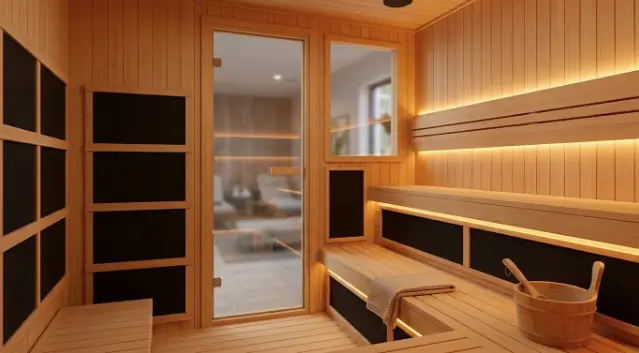
A plug-in infrared cabin under three people is a realistic weekend DIY project for most homeowners with basic tools, typically 4 to 8 hours of assembly and no electrician needed if a 120V outlet already exists nearby. A larger cabin, a hardwired 240V unit, or any outdoor placement that needs a new circuit run is where professional installation earns its cost, both for code compliance and for keeping the electrical warranty intact.
What Does a DIY Kit Actually Involve?
Most infrared kits ship as flat wall panels, a floor, a roof section, and a hardware bag, designed for tongue-and-groove or cam-lock assembly without power tools beyond a screwdriver and a rubber mallet. Basswood and hemlock panels are light enough for one person to lift, though squaring up the walls before securing the roof goes faster with two. Carbon or ceramic heating panels usually come pre-wired into the wall sections, so the buyer is connecting factory harnesses rather than running new wire through the wood.
Total assembly time for a one- or two-person cabin runs 4 to 8 hours for someone comfortable with basic home projects. A three- or four-person cabin with more panels and a bench system can stretch to a full weekend. The bottleneck is rarely the electrical connection, since most residential units plug into a standard 120V, 15-amp outlet. It is squaring the frame and getting the door to seal evenly against the jamb.
What Does a Professional Install Add?
A pro crew brings three things a kit buyer cannot get from instructions alone: a level, code-compliant electrical hookup, correct clearances from walls and any heat-sensitive surfaces, and a warranty that stays intact because the installer can document the work if a claim comes up later. For a straightforward indoor cabin with an outlet already in place, that is often a half-day job. Add a dedicated 240V circuit for a larger cabin, and the timeline extends to two or three days depending on how far the run is from the electrical panel.
Professional install pricing typically ranges from a few hundred dollars for basic placement and hookup to $1,500 or more when new wiring, wall penetrations, or an outdoor pad are involved. That is a real cost on top of the unit price, but it buys documentation that matters if something fails under warranty in year two.
Where Does the Cost Comparison Actually Land?
A DIY kit saves the labor line entirely if the buyer already has a 120V outlet in the intended spot and is comfortable with basic assembly. That is the most common scenario for a small indoor cabin in a spare room, basement corner, or covered porch. The math shifts once a dedicated circuit is needed: running new 240V wiring through finished walls easily costs $500 to $1,500 depending on distance and whether drywall needs to be opened up, and that work should go to a licensed electrician regardless of whether the cabin assembly itself is DIY.
A buyer trying to keep the whole project under budget should compare model pricing directly. Retailers such as https://sweatdecks.com list per-model specs including voltage requirements, so it is possible to filter for a 120V cabin before ordering rather than discovering a 240V requirement after the box arrives and a new circuit turns into an unplanned expense.
Which Skill Level Does Each Option Actually Require?
Kit assembly calls for basic carpentry comfort: reading a diagram, using a screwdriver and a level, and patience with panel alignment. No electrical or plumbing skill is required for a plug-in unit, and most kits include a labeled hardware bag and a numbered panel diagram that walks through wall assembly in sequence. Anyone who has assembled flat-pack furniture can generally manage a two-person infrared kit without much trouble, and the most common mistake first-timers make is rushing the floor panel leveling step, which then makes every wall panel above it slightly out of square.
Professional installation is the right call the moment the project involves opening a wall for new wiring, pouring or leveling an outdoor pad, or meeting a local electrical code that requires a permitted, inspected circuit. Attempting that work without a license is not just a safety risk. In many areas it is not legal, and it can create real problems if the home is sold and an inspector finds unpermitted electrical work. A licensed installer can also usually spot a floor that is out of level or a wall stud pattern that will not hold anchors before the cabin goes up, catching problems a first-time DIY buyer might not notice until the door will not close evenly.
Does the Research on Sauna Use Change Which Option Makes Sense?
The frequency someone expects to actually use the cabin is worth factoring into the install decision. A 2023 review in Mayo Clinic Proceedings on sauna bathing combined with other lifestyle factors describes the strongest associations with cardiovascular outcomes showing up among people using a sauna several times a week, not occasionally. A related review in the American Journal of Physiology on the effects of heat and cold exposure makes a similar point about consistency mattering more than any single session. Most of that evidence base comes from traditional Finnish-style sauna rather than infrared cabins specifically, but the underlying logic still applies: a cabin used several times a week is worth setting up properly the first time, since a rushed DIY connection that needs revisiting later costs more time overall than doing it right, or hiring it out, at the start.
An earlier systematic review of regular dry sauna bathing in Evidence-Based Complementary and Alternative Medicine reaches a comparable conclusion about frequent, sustained exposure. None of this is a reason to pick DIY or professional installation on its own. It is a reason to think about actual weekly use before deciding how much to invest in getting the install right.
Frequently Asked Questions
Can one person assemble an infrared sauna kit alone? A one- or two-person cabin can usually be assembled solo in a weekend, though panel walls are easier to align with a second set of hands. Larger kits are much harder to manage alone since the panels are heavier.
Do infrared sauna kits require a permit? A plug-in 120V cabin placed indoors typically does not require a permit in most jurisdictions. A hardwired 240V unit or an outdoor install with a new circuit often does, so check with the local building department.
How long does professional installation take? A straightforward indoor job with an existing outlet nearby usually takes half a day to a full day. Adding a dedicated circuit run can stretch total time to two or three days.
Does a DIY install void the manufacturer’s warranty? Assembling the cabin rarely affects the warranty if instructions are followed. Wiring a dedicated 240V circuit without a licensed electrician can void the electrical component warranty on some models.
References
- Clinical Effects of Regular Dry Sauna Bathing: A Systematic Review, Evidence-Based Complementary and Alternative Medicine, 2018
- Does the Combination of Finnish Sauna Bathing and Other Lifestyle Factors Confer Additional Health Benefits? A Review of the Evidence, Mayo Clinic Proceedings, 2023
- Effects of heat and cold on health, with special reference to Finnish sauna bathing, American Journal of Physiology – Regulatory, Integrative and Comparative Physiology, 2018
By Trevor Kowalski