Industrial machines often need motors that can start under demanding load conditions, accelerate large mechanical systems, and operate reliably through repeated production cycles. In these applications, engineers must evaluate starting torque, current demand, speed control, thermal limits, and maintenance requirements before selecting an electric motor.
A slip-ring rotor induction motor is one option for applications that benefit from controlled starting characteristics. Understanding its construction and operating principles helps engineers determine whether this design is appropriate for the driven equipment.
Understanding Slip-Ring Induction Motors
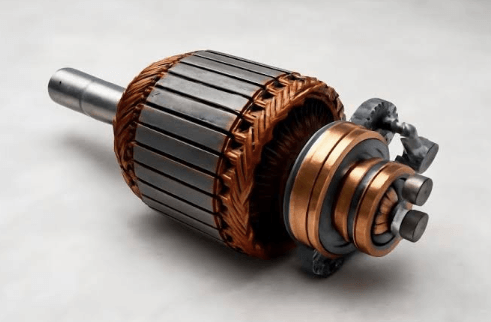
An induction motor converts electrical energy into mechanical rotation through electromagnetic interaction between the stator and rotor. In a conventional squirrel-cage induction motor, the rotor conductors are permanently connected through end rings. A slip-ring design uses a wound rotor connected to external electrical circuits through slip rings and brushes.
This construction allows additional resistance to be introduced into the rotor circuit during starting. When designed and controlled appropriately, this can improve starting torque and help manage starting current compared with some alternative arrangements.
The additional components also introduce maintenance requirements that should be considered when comparing motor technologies.
Why Starting Performance Matters
Many industrial loads require significant torque before they begin moving. Conveyors carrying material, crushers, mixers, and other machinery may present demanding starting conditions.
Starting torque
Starting torque is the torque produced when the motor begins accelerating from rest. If the available torque is insufficient, the motor may struggle to accelerate the load, remain at low speed, or draw excessive current for too long.
A slip-ring design can be configured to provide useful starting characteristics through external rotor resistance. The correct setup depends on the motor, driven load, and operating requirements.
Starting current
Large starting currents can cause voltage dips and place stress on the electrical network. Managing starting current is important when the power supply has limited capacity or several large machines operate on the same system.
The starting arrangement should be designed around the network’s capabilities and the equipment manufacturer’s recommendations.
Acceleration time
Acceleration time depends on the motor’s torque, the load’s inertia, and the torque required throughout the speed range. Engineers should assess whether the motor can accelerate the machine within the permitted thermal and process limits.
How the Rotor Circuit Works
A wound rotor contains conductors connected to slip rings mounted on the rotor shaft. Brushes provide an electrical connection between the rings and an external circuit.
During starting, external resistance can be introduced into the rotor circuit. As the motor accelerates, the resistance may be reduced in stages according to the starter design and control requirements. This changes the motor’s torque-speed characteristics during acceleration.
When the motor reaches its intended operating condition, the external resistance is commonly removed or bypassed according to the system design. The exact arrangement depends on the motor and starter configuration.
The control system must be selected and commissioned correctly to prevent unsuitable resistance settings, prolonged starting, or excessive heating.
Applications and Load Characteristics
Slip-ring induction motors may be considered for industrial machinery with high starting torque requirements or substantial inertia. Potential applications include certain conveyors, crushers, mills, hoists, and process machines, subject to the required rating and design.
Not every heavy-duty application requires this motor type. Engineers should compare alternatives based on starting performance, speed-control requirements, efficiency, capital cost, maintenance resources, and the operating cycle.
For applications with frequent starts, variable speed, or strict process control, the complete motor-drive solution should be evaluated rather than selecting a motor based on one performance characteristic.
Installation and Electrical Compatibility
A slip-ring motor must match the facility’s electrical supply and the driven equipment’s mechanical requirements.
Rated voltage and power
The rated voltage, frequency, output, speed, and current should be verified against the available supply and load calculations. The motor’s duty cycle should also be specified to ensure that thermal requirements are properly considered.
Starter and resistance equipment
The external rotor resistance and starter arrangement must be selected for the motor’s characteristics and required acceleration profile. The control system should provide the intended switching sequence and appropriate protection.
Mechanical alignment
Correct alignment between the motor and driven equipment helps reduce vibration, bearing loads, and coupling wear. The foundation should be suitable for the motor’s mass and operating forces.
Safety and protection
Electrical protection should address foreseeable overloads, short circuits, earth faults, and relevant thermal conditions. Protective functions should be designed by qualified professionals in accordance with applicable standards.
See also: Why Choose a Carbon Fiber Boat Shade Pole for Lightweight, Stable Sun Protection?
Maintenance Considerations
Slip-ring motors have additional components that require inspection compared with many squirrel-cage designs. Brushes, slip rings, rotor connections, and resistance equipment should be maintained according to the manufacturer’s instructions.
Brush and slip-ring condition
Wear, contamination, poor contact, or uneven surfaces can affect electrical performance. Inspection intervals should reflect the motor’s operating environment, starting frequency, and service history.
Rotor resistance equipment
External resistance systems should be inspected for damaged connections, overheating, contamination, and control-system faults. Correct resistance values and switching sequences are important for reliable starting.
Monitoring operating trends
Temperature, vibration, starting time, and other relevant measurements can help identify changes in motor behaviour. Recording these values provides a baseline for maintenance teams and can support earlier fault investigation.
See also: Why Choose a Carbon Fiber Boat Shade Pole for Lightweight, Stable Sun Protection?
Supplier Selection and Technical Documentation
Before requesting a quotation, buyers should provide the required power, voltage, frequency, speed, starting torque, load inertia, duty cycle, and starting frequency. The supplier should also understand the driven machine and the available electrical supply.
Useful documents include technical datasheets, motor drawings, starter diagrams, maintenance instructions, and recommended spare-parts information. Product information for motorxc slip ring rotor induction motor can be reviewed as part of the sourcing process. Confirm the exact configuration, available ratings, starting arrangement, and service requirements directly with the supplier.
Frequently Asked Questions
1. What distinguishes a slip-ring motor from a squirrel-cage motor?
A slip-ring motor has a wound rotor connected through slip rings and brushes, allowing external resistance to be introduced into the rotor circuit. A squirrel-cage motor has a different rotor construction and generally does not use this external resistance arrangement.
2. Why can a slip-ring motor be useful for heavy starting loads?
Its rotor circuit can be configured to provide suitable starting torque and manage acceleration characteristics. The result depends on correct motor selection and starter design.
3. Does a slip-ring motor require additional maintenance?
Yes. Brushes, slip rings, and associated starting equipment require inspection and maintenance according to the manufacturer’s instructions and operating conditions.
Conclusion
Slip-ring rotor induction motors can be suitable for industrial machinery that requires carefully managed starting performance. Their benefits must be weighed against additional components, maintenance needs, and the availability of alternative motor technologies. Evaluating load characteristics, electrical compatibility, starting controls, and lifecycle costs helps engineers select a motor system suited to the application.